

Oral surgery
Oral surgery is one of the specialties of dentistry. It deals with surgical treatment within the oral cavity. This applies to lesions and abnormalities of the soft tissues (gums, mucosa), the hard tissues (bone), and the teeth. It focuses mainly on procedures that do not require hospital treatment

Why choose oral surgery procedures at K2 Dental?
- Experienced team – oral surgery specialists
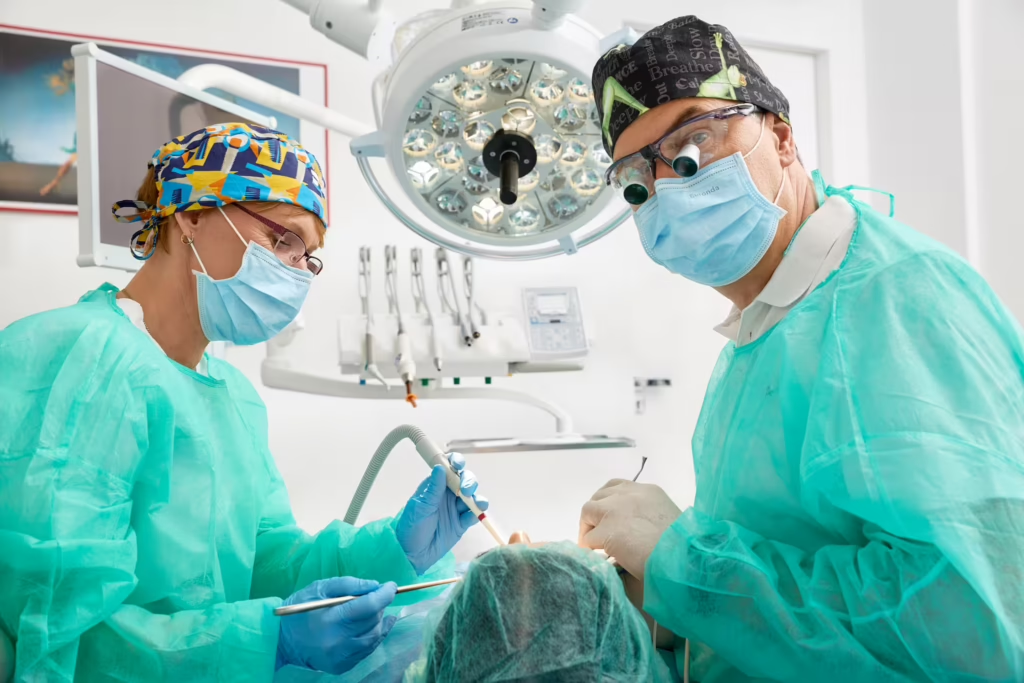
Our clinic employs two dentists with a second-degree specialization in oral surgery – dr n. med. Krystian Krupski and lek. stom. Edyta Kwiecińska. They have been performing surgical procedures for several decades. - We treat the most difficult cases
Their knowledge and experience allow them to treat even the most complex oral surgery cases. - Modern equipment
Our doctors are assisted in the planning and the professional, safe execution of oral surgery procedures by specialized equipment, such as:- the latest-generation digital computed tomography scanner for 3D X-ray imaging
- digital panoramic and cephalometric units from Vatech and Carestream Kodak
- intraoral X-ray units for dental imaging from Vatech and Kodak
- 3Shape intraoral scanner for digital imaging of the entire oral cavity
- surgical lasers that help perform surgery precisely, with minimal invasiveness and safely
- 3D reconstruction computer for planning surgical and implant procedures
- software for the digital design of implant and prosthetic work and minimally invasive surgical procedures
- Comprehensive treatment
A team of specialists and modern multi-specialty equipment make it possible to carry out all stages of a surgical procedure at the K2 Dental Clinic
Surgical procedures at K2 Dental are performed in a minimally invasive and safe manner.
What does wisdom tooth extraction involve?
Oral surgery – scope of procedures
Oral surgery is one of the specialties of dentistry. It deals with surgical treatment within the oral cavity. This applies to lesions and abnormalities of the soft tissues (gums, mucosa), the hard tissues (bone), and the teeth.
It focuses mainly on procedures that do not require hospital treatment. The procedures are performed by an oral surgeon, that is, a dentist who has completed a specialization in this field. The most common procedures:
- extractions (also known as removal) of primary and permanent teeth that can no longer be saved with restorative treatment,
- extractions of impacted teeth or teeth positioned abnormally in the bone – most often wisdom teeth (wisdom tooth extraction),
- extractions of teeth with a complex root system that cannot be removed in the usual way, or of broken roots that a general dentist could not manage (e.g., surgical extraction of teeth),
- procedures to prepare for dentures or orthodontic treatment, e.g., a frenectomy of the lip or tongue frenulum,
- alveolar ridge plastic surgery – plastic closure of an oroantral communication, which sometimes occurs when removing upper molars,
- apicoectomy (root-end resection) of teeth that cannot be fully cured during root canal treatment,
- surgical treatment of inflammatory conditions, such as incision and drainage of intraoral abscesses,
- pre-implant procedures aimed at creating suitable bone conditions for placing implants (including closed and open sinus lift and guided bone regeneration),
- placement of dental implants,
- removal of pathological lesions in the oral cavity (hyperplasia, benign and malignant tumors, cysts, etc.),
- trauma surgery (care for patients after accidents, fractures of the maxilla and mandible, tooth replantation, etc.).
Indications for an oral surgery procedure must be based on a thoroughly taken patient history, a clinical examination, and specialized radiological tests. Our clinic has a state-of-the-art digital radiography system and a Vatech 3D CT scanner, which help us plan and carry out procedures professionally and safely.


Why should you have your wisdom teeth removed before they start to hurt? | dr n.med. oral surgeon Krystian Krupski
Oral surgery and coexisting medical conditions
During the medical interview, the patient should inform the oral surgeon about any general illnesses and the medications they take. This is especially important if the patient has had a myocardial infarction or a stroke, or has previously undergone various cardiac procedures and now takes anticoagulants (commonly called blood thinners).
In these cases, a consultation with the treating physician and possibly a change in medications is often necessary, which makes it possible to perform the procedure safely. Sometimes appropriate laboratory tests before the procedure (blood count, blood clotting times, or other laboratory tests) are essential.
Special preparation for the procedure is also required for patients with diabetes, patients undergoing cancer treatment, and patients taking certain osteoporosis medications (the bisphosphonate group). Among other things, they will require antibiotic coverage started before the planned surgical procedure.
The dental surgeon should also obtain information about the patient’s allergies – this allows the proper choice of anesthesia, pain medications, and, if necessary, antibiotics.
- Some less serious conditions are a temporary contraindication to the procedure – these include, among others, seasonal infections and the common viral cold sore on the lips. In such a case, oral surgery procedures are performed after the general symptoms of the illness have subsided.
Why should some dental procedures be performed by an oral surgeon?
Surgical procedures as part of oral rehabilitation often have to be performed on patients with serious illnesses or while preparing for further surgical treatment (planned cardiac, orthopedic, or eye surgery, before a kidney or other organ transplant).
The aim is to limit possible sources of infection and prevent postoperative complications. In this case, it is very important that the procedures are performed by an oral surgeon whose clinical experience and knowledge ensure proper preparation of the patient, taking their general conditions into account, and a quick and as atraumatic as possible procedure.
This reduces the possibility of postoperative complications and, as a result, the patient’s recovery is shorter. Procedures such as extractions and implant placement should also be performed by a dental surgeon.
Thanks to the surgeon’s knowledge and skills, procedures are performed precisely and with the least possible invasiveness. This allows the procedure to be carried out effectively and safely, with the smallest possible burden on the patient.
What is the difference between an extraction and a surgical extraction of a wisdom tooth? | Dr Paulina Najder K2Dental
Oral surgery during pregnancy
Pregnant women are a special group of patients. In this case we refrain from performing surgical procedures in the first trimester of pregnancy, limiting ourselves only to essential cases. Protecting the fetus from X-ray radiation is also an important matter for this group.
The best time for an expectant mother to have surgical procedures in the oral cavity is the second trimester of pregnancy. We make every effort to ensure the procedure takes place in a comfortable atmosphere for the patient, painlessly and professionally, minimizing the stress associated with a visit to the oral surgeon.
Oral surgery – how to prepare for the procedure?
On the day of the procedure, the patient takes their regular medications as usual, unless they were changed beforehand in consultation with the treating physician in the cases of the conditions described above. It is important that the patient is well rested before the procedure. Good overall condition promotes faster wound healing. You should eat a meal before the procedure.
Oral surgery – aftercare and recovery
- 30-40 minutes after the procedure, you should spit out the dressing that the oral surgeon asks you to bite on immediately after the procedure is finished.
- Do not eat or drink for 2 hours. During the first day after the procedure, lukewarm foods are recommended.
- For the first 2-3 hours after the procedure, the patient should apply cold compresses.
- Pain medication therapy according to the oral surgeon’s recommendations.
- Refrain from smoking for at least 24 hours after the procedure.
- Maintaining good oral hygiene, also according to the oral surgeon’s instructions.
- After most procedures, it is recommended to refrain from rinsing the mouth for the first 3-4 days.
- A follow-up visit with the doctor as recommended.